Uncategorized

The Challenges of Developing Expansive Open-World Games

As you examine into the world of game development, you’ll encounter numerous obstacles when creating expansive open-world games. Your goal is to craft an immersive experience, but you’ll face challenges such as managing vast game environments, optimizing performance, and ensuring a seamless player experience. You’ll need to balance complexity with playability, making it a daunting task. Your understanding of these challenges will help you navigate the development process and create a captivating open-world game.
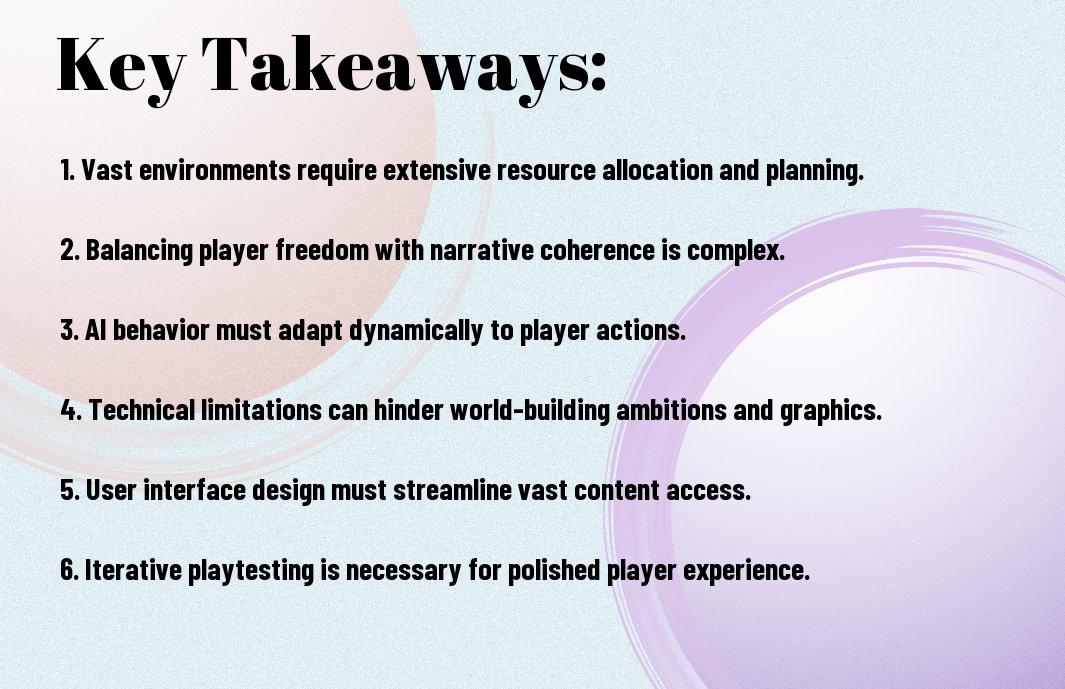
Key Takeaways:

  • Developing expansive open-world games poses significant technical challenges, including managing complex game engines, optimizing performance, and ensuring stability across various platforms.
  • Creating a vast, detailed, and immersive open world requires a substantial amount of time, resources, and manpower, making it a costly and labor-intensive process.
  • Open-world games often suffer from bugs, glitches, and inconsistencies, which can negatively impact the player’s experience and overall game quality.
  • Designing engaging and meaningful gameplay mechanics that take advantage of the open-world setting is a difficult task, as it requires balancing freedom and structure to keep players invested.
  • The sheer scale of open-world games can make it difficult for developers to test and polish every aspect of the game, leading to potential issues and oversights.
  • Player expectations and demands for open-world games are high, with many expecting a high level of realism, complexity, and replayability, which can be challenging for developers to meet.
  • Despite the challenges, successful open-world games can offer a unique and captivating experience, with many developers continuing to push the boundaries of what is possible in this genre, driving innovation and advancement in game development.

World Building Fundamentals

Before submerging into the complexities of open-world game development, you need to establish a solid foundation in world building. This involves creating a rich, immersive environment that draws your players in and keeps them engaged.

Scale and Scope Management

Across the vast expanse of your game world, you must balance scale and scope to create a cohesive experience. You will need to manage the size and complexity of your environment to ensure that it is engaging, yet not overwhelming.

Environmental Storytelling

Along with the physical landscape, you must also consider the narrative elements that bring your world to life. You will use environmental storytelling to convey the history and lore of your game world, making it feel more realistic and immersive.

The environmental storytelling aspect of world building is particularly important, as it allows you to convey complex ideas and themes in a subtle, yet effective manner. As you design your game world, you will need to consider how the environment can be used to tell stories, convey emotions, and create a sense of atmosphere, drawing your players deeper into the world you have created.
Technical Infrastructure

It is no secret that developing expansive open-world games requires a robust technical infrastructure. You will need to invest in high-performance hardware and software to handle the demands of your game. Your development team will also need to have expertise in areas such as programming, graphics design, and level design.

Engine Optimization

Beneath the surface of a well-designed game lies a complex web of optimized code. Between the lines of code, you will find opportunities to improve performance, reduce lag, and enhance the overall gaming experience. Your goal is to create a seamless experience for your players.

Streaming Technologies

With the rise of open-world games, streaming technologies have become increasingly important. With these technologies, you can create vast, detailed environments that load quickly and smoothly, allowing your players to explore without interruption.

Engine developers are continually working to improve streaming technologies, allowing you to create more complex and detailed game worlds. You can use these technologies to load and unload assets in real-time, reducing loading times and improving the overall performance of your game. This enables you to focus on creating engaging gameplay and immersive storylines, rather than worrying about technical limitations.

Content Creation Challenges

For developers, creating an expansive open-world game is a daunting task, as you need to consider various aspects, including level design, storytelling, and gameplay mechanics. You can learn more about the intricacies of open-world game development by visiting Unveiling the Secrets of Open World Game Development to improve your skills.

Asset Production Pipeline

Before stepping into the development process, you should establish a well-structured asset production pipeline to ensure efficient creation and management of your game’s assets, allowing you to focus on other aspects of your project.

Procedural Generation Systems

Procedurally, you will need to consider the use of generation systems to create a vast and diverse game world, as this can help you save time and resources while still providing an immersive experience for your players.

This approach enables you to generate content on the fly, reducing the need for manual creation of every detail, and allowing you to focus on the overall design and feel of your game, as you balance procedural generation with hand-crafted elements to create a unique and engaging experience for your players.

Player Experience Design

To create an immersive open-world game, you need to consider the player’s experience, taking into account their emotions, motivations, and interactions with the game world.

Navigation and Discovery

Deliberately designing intuitive navigation systems and discovery mechanics allows you to guide the player through the game world, ensuring they can explore and engage with the environment effortlessly.

Content Density Balance

Harmonizing the balance between content density and empty space is imperative, as you want to keep the player engaged without overwhelming them with too much information or activities.

Due to the vastness of open-world games, you will face challenges in maintaining this balance, as you need to ensure that the player has enough content to explore and discover, while also providing a sense of freedom and exploration, allowing you to tailor the experience to your vision and the player’s preferences.

Resource Management

Now, as you investigate into developing expansive open-world games, you’ll encounter the challenge of managing resources effectively. Your team, budget, and technology must be allocated wisely to bring your vision to life.

Team Coordination

After establishing your team, you’ll need to ensure that each member is working towards the same goal, with clear communication and defined roles to avoid confusion and delays in your project.

Development Timeline Control

Behind every successful game is a well-planned development timeline, and you must balance your ambition with realistic milestones to maintain control and meet your deadlines.

And as you work on controlling your development timeline, you’ll find that it’s imperative to prioritize features, make tough decisions about what to include or cut, and continually assess your progress to ensure that your game is released on time and meets your quality standards, allowing you to deliver an immersive experience to your players.

Quality Assurance

Despite the excitement of creating an expansive open-world game, you will face significant quality assurance challenges, as the sheer size and complexity of the game world can make it difficult to identify and fix errors.

Bug Testing at Scale

Beneath the surface of a massive open-world game lies a complex web of code, and you will need to test it extensively to ensure a smooth player experience, as even small bugs can have a significant impact on your game’s overall quality.

Performance Optimization

Behind every successful open-world game is a well-optimized engine, and you will need to balance performance and visual quality to create an immersive experience, as your players will expect a seamless and engaging experience.

In fact, performance optimization is an ongoing process that requires careful monitoring and tweaking to ensure that your game runs smoothly on a variety of hardware configurations, and you will need to use various tools and techniques to identify and address performance bottlenecks, ensuring that your game meets your players’ expectations.

Summing up

Following this exploration of the challenges of developing expansive open-world games, you now understand the complexities involved in creating such vast virtual environments. You see that your role as a developer is to balance detail and scope, ensuring a seamless player experience. As you launch on your own game development journey, you will need to consider these challenges and plan your approach carefully to bring your vision to life. Your attention to detail and planning will ultimately determine the success of your game.

FAQ

Q: What are the main challenges that game developers face when creating expansive open-world games?

A: The main challenges that game developers face when creating expansive open-world games include managing the complexity of the game world, ensuring a high level of detail and realism, and optimizing performance to prevent lag and glitches. Additionally, developers must balance the need for a rich and immersive game world with the need for a cohesive and engaging narrative, all while managing the scope and scale of the project to meet deadlines and budget constraints.

Q: How do game developers overcome the technical challenges of creating expansive open-world games, such as rendering and processing large amounts of data?

A: Game developers use a variety of techniques to overcome the technical challenges of creating expansive open-world games, including the use of advanced rendering engines, level of detail (LOD) systems, and data streaming. They also employ optimization techniques such as occlusion culling, physics-based rendering, and multi-threading to improve performance and reduce the load on the game’s engine. Furthermore, developers often use cloud computing and distributed computing to offload processing tasks and reduce the strain on local hardware.

Q: What role does player testing and feedback play in the development of expansive open-world games, and how do developers use this feedback to improve the game?

A: Player testing and feedback play a significant role in the development of expansive open-world games, as they allow developers to identify and fix bugs, balance gameplay mechanics, and refine the overall player experience. Developers use a variety of methods to collect feedback, including alpha and beta testing, player surveys, and online forums. They then use this feedback to make targeted changes to the game, such as adjusting difficulty levels, tweaking gameplay mechanics, and adding new features or content. By incorporating player feedback into the development process, developers can create a more engaging and enjoyable game that meets the needs and expectations of their target audience.

Crafting Unique Gaming Experiences – Lessons from Top Developers

As you investigate into the world of game development, you’ll discover that creating a unique gaming experience is key to captivating your audience. You’ll want to explore the strategies employed by top developers to craft immersive worlds that draw players in. For insights, you can explore resources like The Art of Crafting Immersive Worlds: Inside the Mind of a Virtual Reality Game Developer, which offers a glimpse into the creative process behind innovative games, helping you shape your own approach to game development.

Key Takeaways:

  • Top developers emphasize the importance of innovation and experimentation in game design to create unique gaming experiences that stand out in a crowded market.
  • Understanding the target audience and their preferences is vital in crafting games that resonate with players and meet their expectations.
  • Effective storytelling and immersive gameplay are key elements in creating engaging gaming experiences that draw players in and keep them invested.
  • Developers should be willing to take risks and try new things, as this is often where the most innovative and unique ideas come from.
  • Player feedback and community engagement are important in refining and improving the gaming experience, and can help identify areas for improvement.
  • Attention to detail and a focus on polish can make a significant difference in the overall quality and enjoyment of a game.
  • By combining creative vision, technical expertise, and a deep understanding of player needs, developers can create truly unique and memorable gaming experiences that leave a lasting impression.

    Core Elements of Unique Game Design

    While developing a unique gaming experience, you’ll need to focus on several key elements that set your game apart from others. Your goal is to create an immersive and engaging experience that captures players’ attention and leaves a lasting impression.

    Innovation in Gameplay Mechanics

    One of the most effective ways to differentiate your game is by introducing innovative gameplay mechanics that challenge and surprise you. You can experiment with new controls, levels, or puzzles to keep players engaged and curious.

    World-Building and Narrative Structure

    Any successful game relies on a richly detailed world and a compelling narrative structure that draws you in and refuses to let go. You should consider how to craft a believable and immersive environment that enhances your overall gaming experience.

    Due to the importance of world-building and narrative structure, you’ll want to devote significant time and resources to developing a cohesive and engaging story that complements your gameplay mechanics. As you design your game, consider how you can use environmental details, character backstories, and plot twists to create a unique and captivating experience that keeps you invested in the game world.

    Player Experience and Engagement

    There’s no denying that player experience is at the heart of any successful game, and as a developer, you want to create an experience that draws your players in and keeps them engaged.

    Emotional Connection Through Design

    Above all, you should strive to create a game that fosters an emotional connection with your players, using design elements that evoke feelings and create a lasting impression on your audience.

    Balancing Challenge and Accessibility

    Among the most significant challenges you’ll face as a developer is finding the perfect balance between difficulty and accessibility, ensuring that your game is enjoyable for both new and experienced players.

    Also, as you work to balance challenge and accessibility, you’ll need to consider your target audience and the type of experience you want to create, taking into account factors such as player skill level, learning curve, and overall game complexity, to ensure that your game is engaging and rewarding for your players.

    Technical Foundations

    For a unique gaming experience, you need to establish a solid technical base, considering factors that will impact your game’s performance and overall player satisfaction. Your choices will influence the development process and the final product.

    Engine Selection and Optimization

    Foundational to your game’s success is selecting the right engine and optimizing it for your needs, allowing you to create a tailored experience that meets your vision and your players’ expectations.

    Performance and Platform Considerations

    With performance and platform considerations in mind, you can ensure your game runs smoothly across various devices, enhancing your players’ engagement and enjoyment, and ultimately, the success of your game.

    Consequently, as you research into performance and platform considerations, you will need to think about aspects such as frame rates, resolution, and device capabilities, ensuring that your game is accessible and enjoyable for your target audience, and that you are making the most of your technical foundations to deliver a unique gaming experience that sets you apart.

    Creative Direction

    Despite the many factors that influence game development, your creative direction sets the tone for the entire project. You must consider the overall vision and goals of your game to create a unique experience.

    Art Style Development

    Beneath the surface of every successful game lies a well-planned art style. You will find that developing a consistent aesthetic helps to immerse your players in the game world, making your game more engaging and believable.

    Sound Design Integration

    Following the development of your game’s visual elements, you’ll need to consider the role of sound. You will discover that a well-designed soundtrack and sound effects can greatly enhance the gaming experience, drawing your players deeper into the world you’ve created.

    To take your sound design to the next level, you should experiment with different techniques and technologies, such as 3D audio or adaptive music, to create a more immersive experience. You can also use sound effects to provide feedback to the player, making the game feel more interactive and engaging. By investing time and effort into your sound design, you can create a truly unique and captivating gaming experience that will leave a lasting impression on your players.

    Development Process

    Unlike traditional game development, crafting unique gaming experiences requires a deep understanding of player needs. You can explore how to improve crafting systems in future games by visiting How could MMO developers improve crafting systems in future games to gain insights from industry experts.

    Iterative Design Methods

    Iteratively, you will refine your game design through continuous testing and refinement, allowing you to identify and address issues early on, ensuring a polished final product.

    Feedback Implementation

    Developing a feedback loop with your players is important to creating a unique gaming experience, as you will be able to incorporate their suggestions and ideas into your game.

    To effectively implement feedback, you will need to establish a system for collecting and analyzing player input, and then use this information to make data-driven decisions about your game’s development, allowing you to create a game that meets your players’ needs and exceeds their expectations.

    Market Positioning

    Keep your game’s market positioning in mind when crafting a unique gaming experience, as it will help you stand out from the competition and attract your target audience. You need to understand your game’s strengths and weaknesses to position it effectively in the market.

    Target Audience Definition

    At the outset, identifying your target audience is crucial to create a gaming experience that resonates with them. You should consider factors such as age, preferences, and playing habits to define your audience and tailor your game to meet their needs.

    Unique Selling Points

    Around the concept of unique selling points, you should focus on what sets your game apart from others in the market. You can achieve this by introducing innovative gameplay mechanics, stunning visuals, or an engaging storyline that captures your audience’s attention.

    For instance, you can create a unique selling point by incorporating player choice and consequence, allowing players to shape the game’s narrative and outcome. This will not only make your game more engaging but also increase replayability, as you will want to experiment with different choices and see how the story unfolds. By incorporating such features, you can differentiate your game from others and make it more appealing to your target audience.

    Final Words

    Upon reflecting on the insights from top developers, you can now appreciate the art of crafting unique gaming experiences. You have gained valuable knowledge to enhance your own gaming projects, from innovative design to engaging storytelling. By applying these lessons, you will be able to create immersive experiences that captivate your audience and set your games apart. Your understanding of the development process has been enriched, empowering you to push boundaries and shape the future of gaming.

    FAQ

    Q: What are the key elements that top game developers focus on when crafting unique gaming experiences?

    A: Top game developers focus on several key elements to craft unique gaming experiences, including immersive storytelling, engaging gameplay mechanics, and detailed game worlds. They also prioritize player choice and agency, allowing players to shape the game world and story through their actions. Additionally, they often incorporate innovative technologies, such as artificial intelligence and virtual reality, to create a more immersive and interactive experience. By combining these elements, developers can create games that stand out from the crowd and leave a lasting impression on players.

    Q: How do top developers balance creativity and commercial viability when designing a new game?

    A: Top developers balance creativity and commercial viability by taking a player-centric approach to game design. They conduct extensive market research and player testing to identify trends and preferences, and use this information to inform their design decisions. At the same time, they also prioritize innovation and creativity, giving their teams the freedom to experiment and try new things. By finding a balance between these two approaches, developers can create games that are both commercially successful and creatively fulfilling. This may involve taking calculated risks, such as introducing new gameplay mechanics or genres, and being open to feedback and iteration throughout the development process.

    Q: What role does community engagement play in crafting unique gaming experiences, and how do top developers foster a sense of community around their games?

    A: Community engagement plays a vital role in crafting unique gaming experiences, as it allows developers to build a loyal player base and create a shared sense of ownership and investment in the game. Top developers foster a sense of community by engaging with players through social media, forums, and other channels, and by incorporating player feedback and suggestions into the game. They also create opportunities for players to interact with each other, such as multiplayer modes, community events, and user-generated content tools. By building a strong community around their games, developers can create a loyal following and encourage players to share their experiences with others, helping to drive word-of-mouth marketing and increase the game’s overall reach and impact.

Retro Revival – Why Classic Games Continue to Inspire

As you probe into the world of gaming, you’ll notice a phenomenon where classic games continue to captivate your attention. You’ll find that your favorite childhood games still evoke a sense of nostalgia and excitement. Your interest in retro games is not isolated, as many gamers are revisiting and rediscovering the charm of older titles, leading to a resurgence of classic gaming inspiration in modern game development, and you are likely wondering what drives this trend.

Key Takeaways:

  • The nostalgia factor plays a significant role in the enduring popularity of classic games, as they evoke a sense of nostalgia and familiarity among players who experienced them in their childhood.
  • Classic games have a timeless appeal, with many of their core mechanics and design elements still influencing modern game development, making them a valuable source of inspiration for contemporary game designers.
  • The simplicity and accessibility of retro games are major factors in their continued appeal, as they often feature intuitive controls and straightforward gameplay that can be picked up by players of all ages and skill levels.
  • Retro games have a distinct aesthetic and audio style that is often emulated or paid homage to in modern games, with many developers seeking to capture the charm and character of classic titles in their own work.
  • The rise of retro gaming communities and online platforms has made it easier than ever for players to access and play classic games, helping to introduce them to new audiences and foster a sense of community among fans.
  • Classic games continue to inspire new generations of game developers, with many modern titles drawing direct inspiration from retro classics, and some even using original assets or code to create new experiences.
  • The preservation of classic games is an important aspect of gaming culture, with efforts to emulate, port, and re-release retro titles helping to ensure that they are not lost to time and can continue to be enjoyed by players for years to come.

The Pull of Nostalgia

A trip down memory lane, you can learn more about the Retro Gaming Revival – Why Classic Games are Trending Again, and how it influences your gaming preferences.

Emotional Connection to Past Gaming

Around your favorite childhood games, you likely have fond memories, and this emotional connection is a significant factor in the retro gaming revival.

Shared Generational Experiences

The shared experiences of playing classic games with others create a sense of community and camaraderie, which you can still tap into today.

Consequently, as you revisit these classic games, you’re not only reliving your own memories but also connecting with others who share your passion, and this collective nostalgia has contributed to the enduring popularity of retro games.

Technical Simplicity

If you look back at classic games, you’ll notice that their technical simplicity is part of their charm. With limited resources, developers had to focus on creating engaging gameplay, leading to more streamlined experiences.

Focused Gameplay Mechanics

Above all, the simplicity of classic games allowed for focused gameplay mechanics, letting you enjoy the core experience without distractions, making it easier for you to appreciate the game’s essence.

Accessibility Across Platforms

Simplistically, classic games can be played on various platforms, including older hardware, allowing you to access and enjoy them without needing the latest technology, making your gaming experience more flexible.

But as you research deeper into the world of classic games, you’ll find that their accessibility across platforms is not just about playing on old consoles, but also about the ability to play on modern devices, such as smartphones and tablets, through emulation or ports, giving you the freedom to play your favorite classic games anywhere, at any time, and on your preferred device.

Design Philosophy

Keep in mind that classic games’ design philosophies continue to influence modern game development, as you notice the emphasis on simplicity, challenge, and player engagement.

Pixel Art Renaissance

For fans of retro aesthetics, the resurgence of pixel art is a welcome trend, as you see it being used in modern games to create a nostalgic and charming visual style.

Classic Sound and Music Impact

For instance, you can hear the influence of classic video game soundtracks in modern music, with many artists incorporating chiptune elements into their work, and you can experience the impact of sound effects on your overall gaming experience.

Also, as you research deeper into the world of classic games, you’ll find that the sound and music play a significant role in creating an immersive atmosphere, and you can appreciate how these elements contribute to the game’s overall charm and nostalgic value, making you want to play them over and over again.

Modern Adaptations

To experience the nostalgia of classic games, you can explore modern adaptations that pay homage to the originals. These adaptations breathe new life into beloved titles, introducing them to a new generation of gamers.

Indie Developer Movement

On the independent gaming scene, you’ll find developers creating games that draw inspiration from retro classics. You can discover unique titles that blend old-school gameplay with modern twists, offering a fresh perspective on familiar genres.

Remakes and Remasters

Behind the success of remakes and remasters lies a dedicated community of gamers like you, who appreciate the attention to detail and care that goes into reimagining classic games. You can enjoy enhanced graphics, new soundtracks, and refined gameplay that stay true to the spirit of the originals.

In addition, as you probe into remakes and remasters, you’ll notice that they often include new content, such as bonus levels, characters, or storylines, which can enhance your overall gaming experience and provide a new perspective on the classic games you love.

Social Impact

Despite the rise of new technologies, classic games continue to influence your gaming experience. You can learn more about the rise of nostalgia in modern gaming and its effects on your favorite games.

Community Building

One of the key aspects of classic games is their ability to bring people together, allowing you to connect with others who share your interests and passions, forming a sense of community around your favorite games.

Competitive Gaming Roots

To understand the social impact of classic games, you need to look at their competitive roots, which have shaped your gaming experience and influenced the way you interact with others in the gaming world.

Indeed, as you explore the world of competitive gaming, you will find that classic games have played a significant role in shaping your skills and strategies, and have paved the way for modern esports, allowing you to compete with others and showcase your talents.

Market Influence

Your favorite classic games have a lasting impact on the gaming industry, with many modern titles drawing inspiration from retro classics, and you can see this influence in the market trends and sales figures.

Retro Gaming Economy

Influenced by the nostalgia of older gamers, the retro gaming economy has grown significantly, with you being able to purchase classic consoles and games, and even new titles that mimic the style of older games.

Collection and Preservation

Besides the economic aspect, collecting and preserving classic games has become a popular hobby, with you being able to find and restore old consoles and games, and share your collection with others.

The process of collecting and preserving classic games not only helps to maintain the history of the gaming industry but also allows you to experience and appreciate the evolution of gaming, with you being able to play and compare older games with newer titles, and see how the industry has progressed over time.

Summing up

With this in mind, you can see why classic games continue to inspire your passion for gaming. You experience a sense of nostalgia and familiarity, which draws you back to retro games. Your love for these games is a testament to their timeless appeal, and you continue to find new ways to enjoy them, whether through re-releases or modern reinterpretations, allowing you to relive your favorite gaming memories.

FAQ

Q: What is the appeal of retro games in the modern gaming industry?

A: The appeal of retro games lies in their nostalgic value, simplicity, and the fact that they often introduced innovative gameplay mechanics that have stood the test of time. Many classic games have a certain charm that is hard to replicate with modern graphics and complex storylines. The simplicity of retro games allows players to focus on the gameplay itself, rather than being overwhelmed by detailed graphics and lengthy cutscenes. This simplicity, combined with the nostalgic factor, makes retro games appealing to both old and new generations of gamers.

Q: How do classic games continue to inspire modern game development?

A: Classic games continue to inspire modern game development in several ways. Many modern games draw inspiration from the gameplay mechanics, level design, and artistic styles of retro games. For example, the indie game scene is filled with games that pay homage to classic titles, such as platformers and puzzle games. Additionally, many modern games incorporate elements of retro games, such as pixel art graphics or chiptune soundtracks, to create a unique and nostalgic experience. The influence of retro games can also be seen in the resurgence of classic genres, such as side-scrollers and point-and-click adventure games.

Q: What role do retro games play in the preservation of gaming history and culture?

A: Retro games play a significant role in the preservation of gaming history and culture. They serve as a window into the past, allowing players to experience the evolution of the gaming industry and the technological advancements that have shaped it. Many retro games are also culturally significant, reflecting the societal values and attitudes of their time. The preservation of retro games, through efforts such as game archives and emulation, ensures that these cultural artifacts are not lost to time. Furthermore, the continued interest in retro games helps to promote a sense of community among gamers, with many fans sharing their passion for classic games through online forums, social media, and retro gaming events.

The Rise of Sandbox Games – Unleashing Creative Freedom

As you explore the world of gaming, you’ve likely noticed a shift towards sandbox games that offer unparalleled creative freedom. You’re no longer limited to linear storylines, instead, you’re given the power to shape your own experiences. With your imagination as the only boundary, you can build, explore, and interact with virtual worlds in ways that were previously unimaginable. Your gaming experience is about to get a whole lot more personal and exciting, and this blog post will examine into the details of this gaming revolution.

Key Takeaways:

  • The rise of sandbox games has led to a significant shift in the gaming industry, offering players unprecedented creative freedom and immersive experiences.
  • Sandbox games provide players with open-world environments, allowing them to explore, experiment, and express themselves in unique and innovative ways.
  • Games like Minecraft and Terraria have popularized the sandbox genre, inspiring a new generation of gamers and game developers to embrace creative freedom and open-ended gameplay.
  • Sandbox games often feature procedurally generated content, which enables endless possibilities for exploration and discovery, keeping players engaged for hours on end.
  • The creative freedom offered by sandbox games has also led to the development of vibrant online communities, where players share their creations, collaborate on projects, and learn from one another.
  • Sandbox games have also become an important tool for education and learning, allowing players to develop crucial skills such as problem-solving, critical thinking, and creativity in a fun and interactive way.
  • The success of sandbox games has paved the way for new and innovative genres, such as survival games and open-world RPGs, which continue to push the boundaries of creative freedom and immersive gameplay.

Evolution of Sandbox Gaming

The concept of sandbox gaming has undergone significant transformations over the years, offering you a unique experience with each new iteration. As you explore the world of sandbox games, you’ll notice a shift from restrictive gameplay to open-world adventures.

From Linear to Open World

Gamers have witnessed a remarkable transition from linear gameplay to open-world experiences, allowing you to explore and interact with your surroundings in a more immersive way. You can now experiment with different playstyles and storylines, making your gaming experience more personalized.

Technical Milestones

Toward the development of more sophisticated sandbox games, advancements in technology have played a significant role, enabling you to enjoy seamless gameplay and stunning visuals. You can appreciate the attention to detail and complexity of the game worlds, making your experience even more engaging.

Indeed, as you research deeper into the world of sandbox games, you’ll notice that technical milestones have been instrumental in shaping your gaming experience. You can now enjoy features like dynamic weather, destructible environments, and advanced AI, all of which contribute to a more realistic and interactive gameplay experience, allowing you to express your creativity and freedom in a virtual world tailored to your preferences.

Core Elements of Sandbox Design

While designing a sandbox game, you can draw inspiration from various sources, such as The Sandbox Game: Unleashing Creativity and Freedom, to create an immersive experience, allowing you to unleash your creative freedom.

Player Agency

Besides the game’s overall design, you will notice that player agency plays a significant role in sandbox games, as it enables you to make choices that impact the game world, giving you a sense of control and ownership over your experience.

Environmental Interaction

Below the surface of a sandbox game’s open world, you will find a complex system of interactions that allow you to manipulate and shape the environment, creating a unique and dynamic experience tailored to your preferences.

Hence, as you explore the world of sandbox games, you will discover that environmental interaction is a key aspect of the genre, enabling you to build, explore, and experiment with the game’s world, unlocking new possibilities and discovering hidden secrets, and allowing you to express your creativity and bring your ideas to life.

Creative Tools and Mechanics

All sandbox games offer a wide range of creative tools and mechanics that allow you to express your imagination and bring your ideas to life. You can build, explore, and interact with the game world in a way that feels intuitive and engaging.

Building Systems

Behind every great sandbox game is a robust building system that lets you construct and shape the world around you. You can use various materials and tools to create structures, from simple shelters to complex machines, and experiment with different designs and layouts.

Resource Management

At the heart of every sandbox game is a resource management system that challenges you to gather, craft, and utilize resources effectively. You must balance your needs and priorities, making tough decisions about how to allocate your resources and optimize your gameplay experience.

Systems like resource management enable you to develop a sense of ownership and investment in your gameplay experience. As you gather and manage resources, you will uncover new items, tools, and recipes that expand your creative possibilities and open up new avenues for exploration and discovery, allowing you to tailor your experience to your unique preferences and playstyle.

Social Impact and Community

Your engagement with sandbox games extends beyond the virtual world, as you become part of a larger community that shares your passion for creative freedom and self-expression.

Player-Created Content

Following the rise of sandbox games, you’ll find a plethora of user-generated content that showcases your creativity and talent, inspiring others to do the same.

Shared Experiences

Collectively, you and your fellow players create a unique and dynamic environment that fosters collaboration and social interaction, leading to lasting memories and a sense of belonging.

Shared experiences in sandbox games allow you to connect with like-minded individuals, learn from their approaches, and adapt their ideas to enhance your own gameplay, ultimately enriching your overall experience.

Genre-Defining Games

For your understanding of sandbox games, it’s important to explore the titles that have shaped the genre, offering you unparalleled creative freedom and immersive experiences.

Minecraft’s Revolution

The emergence of Minecraft marked a significant turning point, as you were able to build and explore vast blocky worlds, sparking your imagination and creativity.

GTA’s Open World Legacy

At the forefront of open-world gaming, Grand Theft Auto (GTA) series has been a benchmark, allowing you to roam freely and engage in various activities, setting a high standard for your gaming expectations.

Further exploring GTA’s open-world legacy, you’ll find that the series has consistently pushed boundaries, providing you with richly detailed environments, complex characters, and engaging storylines, ultimately influencing your perception of what a sandbox game should offer, and you can expect similar experiences from other games in the genre, as they strive to match the standard set by GTA.

Future Directions

Now that sandbox games have become a staple of the gaming industry, you can expect even more innovative and immersive experiences to emerge, offering you unparalleled creative freedom and endless hours of entertainment.

Emerging Technologies

Between the advancements in virtual reality and artificial intelligence, you will witness a new era of sandbox games that blur the lines between the physical and virtual worlds, allowing you to interact with your environment in unprecedented ways.

Procedural Generation

Along with the growth of sandbox games, you will see a greater emphasis on procedural generation, enabling you to create unique and dynamic worlds that are tailored to your preferences and playstyle, offering you a distinct experience each time you play.

To fully appreciate the potential of procedural generation, you should consider how it can be used to create complex and diverse environments, complete with their own ecosystems, geography, and rules, allowing you to explore and interact with your surroundings in a highly realistic and engaging manner, and as you probe deeper into these worlds, you will discover that the possibilities are endless, and your creativity is the only limit.

Summing up

Drawing together the threads of the rise of sandbox games, you can see how they offer you unparalleled creative freedom. As you explore these virtual worlds, you unlock your imagination and bring your unique ideas to life. With the ability to shape and mold your experience, you are no longer limited by traditional gameplay boundaries, and your creativity knows no bounds, allowing you to enjoy a truly immersive experience.

FAQ

Q: What are sandbox games and how do they promote creative freedom?

A: Sandbox games are a type of video game that offers players a high degree of autonomy and creative freedom, allowing them to explore, build, and interact with a virtual world in a non-linear fashion. These games provide players with a set of tools, resources, and rules, but do not dictate a specific objective or storyline, enabling players to express themselves and bring their imagination to life. By providing an open-ended and dynamic environment, sandbox games unleash creative freedom, encouraging players to experiment, innovate, and push the boundaries of what is possible within the game world.

Q: What are some notable examples of sandbox games that have contributed to their rise in popularity?

A: Some notable examples of sandbox games that have contributed to their rise in popularity include Minecraft, Terraria, and Grand Theft Auto V. Minecraft, for instance, has become a cultural phenomenon, allowing players to build and explore a blocky, pixelated world filled with creatures, resources, and treasures. Terraria, on the other hand, offers a 2D sandbox experience, where players can dig, build, and battle their way through a procedurally generated world. Grand Theft Auto V, an open-world sandbox game, provides players with a vast, detailed environment to explore, complete with a rich storyline, engaging characters, and a wide range of activities and missions.

Q: How have sandbox games influenced the gaming industry and what can we expect from future sandbox game developments?

A: The rise of sandbox games has significantly influenced the gaming industry, as they have changed the way games are designed, developed, and played. Sandbox games have raised the bar for player engagement, creativity, and immersion, forcing game developers to rethink their approach to game design and player interaction. As for future developments, we can expect to see even more sophisticated and immersive sandbox games, with advanced graphics, physics, and artificial intelligence. The incorporation of new technologies, such as virtual reality (VR) and augmented reality (AR), will further enhance the sandbox gaming experience, providing players with even more realistic and interactive environments to explore and create within.

Designing Perfect Tutorials – Easing New Players into Complex Games

As you develop your game, you want to ensure that new players can easily navigate its complex mechanics. You understand that a well-designed tutorial is crucial to keeping players engaged. Your goal is to create an introduction that is both intuitive and informative, setting your players up for success. By crafting a thoughtful and well-structured tutorial, you can help your players build confidence and develop the skills they need to fully enjoy your game.

Key Takeaways:

  • Introduce game mechanics gradually, allowing players to absorb and understand each element before adding more complexity to prevent overwhelm and frustration.
  • Use interactive tutorials that let players learn by doing, rather than passive tutorials that only provide information, to increase engagement and retention.
  • Make tutorials concise and to the point, avoiding unnecessary information that might confuse or distract new players from the main gameplay.
  • Provide clear and consistent feedback to players during tutorials, helping them understand what they are doing correctly or incorrectly and how to improve.
  • Use visual cues, such as highlighted buttons or on-screen prompts, to guide players through tutorials and draw attention to important elements.
  • Test tutorials with real players to identify areas of confusion or difficulty and make adjustments to improve the learning experience.
  • Consider using optional advanced tutorials or tips for experienced players, allowing them to skip basic information and dive deeper into the game’s mechanics and strategies.

    Core Principles of Tutorial Design

    A well-designed tutorial is crucial for easing new players into complex games, and you should consider several key factors when creating your tutorial, including the player’s experience and the game’s mechanics.

    Progressive Complexity Layers

    With each new concept introduced, you will be able to build upon previous knowledge, allowing your players to gradually absorb the game’s complexity and deepen their understanding of the mechanics.

    Reward-Based Learning Steps

    Steps to implement reward-based learning include setting clear goals and providing incentives for achieving them, which will help your players stay motivated and engaged throughout the tutorial.

    Also, as you design your reward-based learning steps, you will want to ensure that the rewards are meaningful and relevant to the player’s progress, providing a sense of accomplishment and encouraging them to continue learning and improving their skills.

    Player Psychology in Learning

    Even when designing tutorials, you should consider the psychological aspects of learning, as this will help you create a more effective and engaging experience for your players. You can learn more about Creating Positive User Experiences When Introducing Players to Your Game to improve your tutorial design.

    Cognitive Load Management

    Across various studies, it has been shown that managing cognitive load is vital for effective learning, and you can apply this principle to your tutorial design by breaking down complex information into manageable chunks, allowing your players to absorb and process the information more easily.

    Motivation and Achievement Patterns

    Any well-designed tutorial should also take into account the motivation and achievement patterns of your players, as this will help you create a sense of progression and accomplishment, keeping your players engaged and motivated throughout the learning process.

    Understanding what motivates your players and how they respond to achievements is key to designing an effective tutorial. You can use this knowledge to create a sense of progression and accomplishment, providing your players with a sense of pride and satisfaction as they complete each level or achieve specific goals, which will keep them engaged and motivated to continue playing and learning.

    Interactive Teaching Elements

    Keep your tutorials engaging with interactive elements that encourage participation and learning. You can use quizzes, puzzles, or challenges to test your players’ understanding and provide a sense of accomplishment.

    Contextual Help Systems

    Intuitively, you can design help systems that provide relevant information at the right time, reducing frustration and guiding your players through complex gameplay mechanics.

    Dynamic Feedback Mechanisms

    The key to effective learning is providing timely and relevant feedback, allowing you to adjust your approach and improve your skills, and you can achieve this by incorporating dynamic feedback mechanisms into your tutorials.

    Teaching through dynamic feedback mechanisms involves providing your players with immediate feedback on their actions, helping you to identify areas where they need improvement and adjust your tutorial accordingly, ensuring that your players stay engaged and motivated throughout the learning process, and you can use various techniques such as visual cues, audio feedback, or even gentle nudges to guide your players in the right direction.

    Tutorial Pacing Structures

    All well-designed tutorials have a pacing structure that eases new players into complex games, and you should consider this when creating your own. You want to ensure that your players are engaged and learning at a comfortable pace, without feeling overwhelmed or bored.

    Milestone-Based Progression

    Any successful tutorial will use milestone-based progression to guide players through the game, and you can achieve this by setting clear goals and objectives for your players to complete. You will find that this approach helps to create a sense of accomplishment and motivation, as players progress through the game.

    Skill Gate Implementation

    By implementing skill gates, you can control the flow of information and ensure that players have mastered the necessary skills before progressing to more complex content. You can use this technique to prevent players from becoming frustrated or stuck, and to create a more enjoyable learning experience.

    Further implementation of skill gates involves careful consideration of your game’s mechanics and the skills required to progress. You will need to identify the key skills that players must master, and design gates that test these skills in a fair and challenging way, allowing you to create a tutorial that is both effective and engaging for your players.

    Visual and Audio Guidance

    For effective onboarding, you can leverage visual and audio cues to guide new players. You can learn more about this by checking out the tips on How to Design Games for New Players: Tips and Principles, which will help you create an engaging experience.

    Interface Element Highlighting

    With intuitive interface design, you can draw attention to key elements, making it easier for new players to navigate your game. You can use visual effects, such as animations or highlights, to guide their focus.

    Sensory Learning Cues

    Elementary sensory cues, like sound effects or vibrations, can enhance the learning experience, providing feedback and reinforcement as players progress through your game.

    Interface design plays a significant role in sensory learning cues, as you can use a combination of visual, audio, and haptic feedback to create an immersive experience, helping new players understand the game mechanics and interact with your game world more effectively, making it easier for you to design engaging tutorials.

    Testing and Iteration Methods

    To ensure your tutorials are effective, you need to test them with real players and iterate on the design based on the feedback and results you receive.

    Player Behavior Analysis

    Behaving as a player would, you can analyze how users interact with your tutorial, identifying areas where they get stuck or lose interest, allowing you to make targeted improvements.

    Tutorial Effectiveness Metrics

    At the core of evaluating your tutorial’s success are metrics that measure player engagement, retention, and overall understanding of the game mechanics, which you can use to refine your design.

    Also, by tracking these metrics, you can determine which parts of the tutorial are most effective and which need revision, enabling you to create a more streamlined and efficient learning experience for your players, ultimately enhancing their overall enjoyment of the game.

    Summing up

    So, as you design tutorials for complex games, you will find that your approach has a significant impact on the player’s experience. You can ease new players into the game by introducing mechanics gradually, providing clear instructions, and offering feedback. By doing so, you create an engaging and enjoyable experience, helping your players build confidence and develop the skills needed to progress through the game, making your tutorial a valuable asset to your overall game design.

    FAQ

    Q: What is the primary goal of designing perfect tutorials for complex games?

    A: The primary goal of designing perfect tutorials is to create an engaging and intuitive experience that eases new players into the game, helping them understand the mechanics, rules, and objectives without feeling overwhelmed or frustrated. A well-designed tutorial should provide a gentle learning curve, allowing players to build confidence and develop the skills necessary to enjoy the game to its fullest potential. By doing so, developers can increase player retention, improve overall satisfaction, and encourage players to continue playing and exploring the game.

    Q: How can game developers balance the need to teach complex gameplay mechanics with the risk of overwhelming new players?

    A: To balance the need to teach complex gameplay mechanics with the risk of overwhelming new players, game developers can use a variety of techniques, such as breaking down complex mechanics into smaller, manageable chunks, and introducing them gradually through a series of interactive lessons or challenges. Additionally, developers can use visual cues, audio feedback, and subtle hints to guide players through the learning process, rather than relying on lengthy text-based instructions or dry tutorials. By using a combination of these approaches, developers can create a tutorial experience that is both informative and engaging, allowing players to learn at their own pace and develop a deep understanding of the game’s mechanics.

    Q: What role does player feedback and testing play in the design of effective tutorials for complex games?

    A: Player feedback and testing play a vital role in the design of effective tutorials for complex games. By testing the tutorial with a diverse group of players and gathering feedback on their experiences, developers can identify areas where the tutorial may be confusing or overwhelming, and make targeted improvements to address these issues. This can involve refining the pacing and content of the tutorial, adjusting the level of difficulty, or adding additional guidance and support to help players overcome specific challenges. By iterating on the tutorial design based on player feedback, developers can create a more effective and enjoyable learning experience that meets the needs of new players and helps them to succeed in the game.

HT-fff Skip to content