As you explore the world of gaming, you’re likely wondering which technology will revolutionize your experience: Virtual Reality (VR) or Augmented Reality (AR). You’re considering how these technologies will impact your gaming sessions, and which one will provide the most immersive experience. Your curiosity is justified, as both VR and AR are transforming the gaming landscape, offering unique benefits and drawbacks that will influence your gaming future.
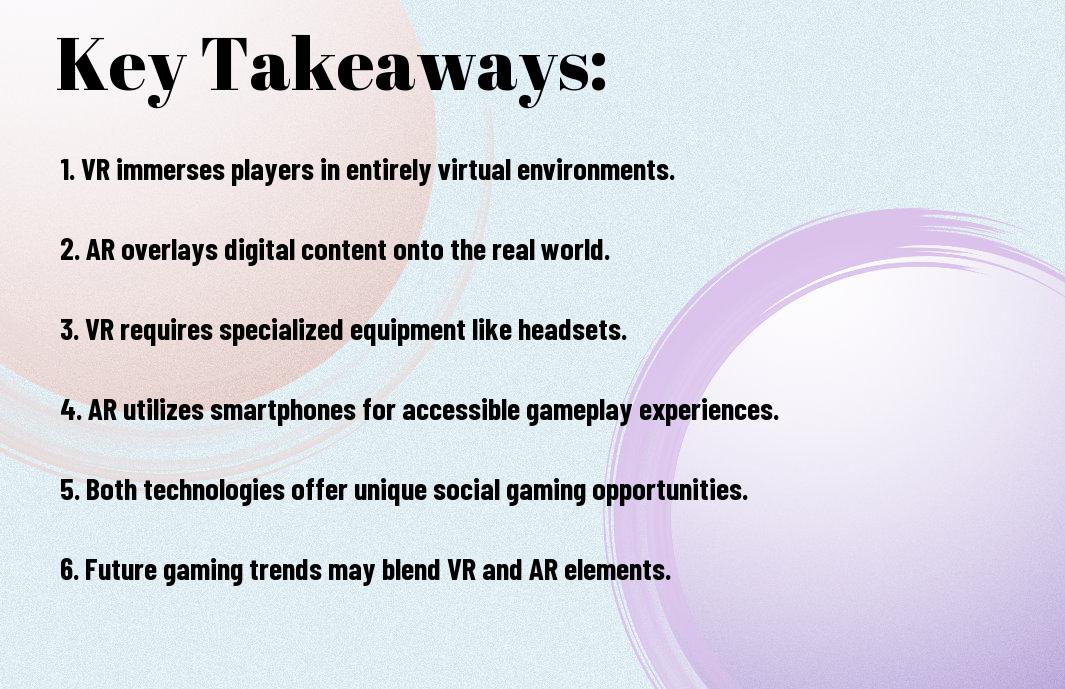
Key Takeaways:
- Virtual Reality (VR) and Augmented Reality (AR) are two distinct technologies that are transforming the gaming industry in different ways, with VR providing a fully immersive experience and AR enhancing the real world with virtual elements.
- VR technology is currently more advanced in terms of gaming applications, with popular devices like Oculus and Vive offering high-end experiences, while AR is still developing its gaming capabilities.
- AR has the potential to reach a broader audience due to its accessibility on mobile devices and its ability to blend seamlessly into everyday life, making it a significant player in the future of gaming.
- The cost of VR equipment is currently a barrier to adoption, while AR can be experienced through smartphones and tablets, making it more affordable and widely available.
- Both VR and AR offer new opportunities for game developers to create innovative and interactive experiences, with VR focusing on immersive storytelling and AR on interactive, real-world engagements.
- The future of gaming is likely to involve a combination of both VR and AR technologies, as they complement each other and offer unique experiences that can coexist and enhance the gaming landscape.
- As technology continues to evolve, we can expect to see significant advancements in both VR and AR, leading to new and exciting developments in the gaming industry that will shape the future of interactive entertainment.
The Core Foundations
To understand the differences between VR and AR, you can explore the pros and cons of each technology, as discussed in Virtual Reality vs Augmented Reality in Gaming: Pros and Cons, to make an informed decision about which one is shaping the future of gaming.
Virtual Reality Fundamentals
With the basics of VR, you’ll discover how it immerses you in a completely virtual world, shutting out your physical surroundings, and offering an engaging gaming experience.
Augmented Reality Essentials
After exploring AR, you’ll find that it enhances your real-world environment with virtual objects and information, creating a unique gaming experience that blends the physical and digital worlds.
Hence, as you research deeper into AR, you’ll notice how it uses your device’s camera to display virtual objects in the real world, allowing you to interact with them in a more immersive way, and opening up new possibilities for gaming and beyond, which will likely influence your perception of what gaming can be.
Hardware Evolution
If you’re considering the future of gaming, you need to look at the advancements in hardware. You’ll notice significant improvements in both VR and AR technologies, enabling more immersive experiences.
VR Headsets and Controllers
Contrary to what you might think, VR headsets and controllers have become more sophisticated, offering better tracking and higher resolution. You can expect a more realistic experience with your VR games.
AR Devices and Wearables
Among the latest developments, AR devices and wearables have started to gain traction, with companies investing heavily in this technology. You can expect to see more AR-enabled devices in the near future.
And as you explore the world of AR devices and wearables, you’ll find that they offer a more integrated experience, allowing you to interact with your surroundings in a more seamless way, enhancing your overall gaming experience with augmented reality.
Gaming Applications
Your gaming experience is about to change with the integration of VR and AR technologies, as you can learn more about in AR VR Shaping Gaming’s Future: A Billion-Dollar Industry.
VR Gaming Experiences
Previously, you had to imagine immersive gaming worlds, but now VR technology brings them to life, offering you unparalleled gaming experiences.
AR Gaming Innovations
Beneath the surface of traditional gaming lies a new world of AR innovations, waiting for you to explore and engage with your surroundings in entirely new ways.
Further, as you examine into AR gaming, you’ll discover how it blends the physical and digital worlds, creating interactive and dynamic experiences that you can’t find in traditional gaming, and this is just the beginning of what you can expect from this emerging technology.
Market Impact
After analyzing the current landscape, you can see that both VR and AR are making significant waves in the gaming industry, with each having its own unique advantages and disadvantages that will impact your gaming experience.
Current Gaming Trends
Prior to the latest developments, you were likely accustomed to traditional gaming methods, but now you have the option to explore new immersive experiences that are changing the way you play games.
Consumer Adoption Rates
Acceptance of these technologies is growing rapidly, and as you consider which one to invest in, you should look at the adoption rates of VR and AR to determine which one is leading the charge in the gaming industry.
And as you probe deeper into the consumer adoption rates, you will notice that VR has a strong following among gamers who value immersive experiences, while AR is gaining traction among those who prefer a more interactive experience that blends the virtual and real worlds, allowing you to make a more informed decision about which technology is right for your gaming needs.
Technical Challenges
Many technical hurdles need to be overcome for VR and AR to reach their full potential in gaming. You will encounter various obstacles, including high costs, limited content, and technical issues.
VR Limitations
Around the time you start exploring VR, you’ll notice limitations such as restricted movement and image resolution. You will need to consider these limitations when developing your gaming experience.
AR Development Hurdles
Behind the scenes, you’ll find that developing AR games poses significant challenges, including complex software and hardware requirements. You will need to navigate these hurdles to create an immersive experience.
Challenges in AR development also involve ensuring seamless integration with real-world environments, which can be complex and time-consuming. You will need to consider factors such as lighting, sound, and user interaction to create a realistic and engaging experience, and as you examine deeper into AR development, you’ll find that overcoming these challenges is necessary to creating immersive and interactive games that push the boundaries of what is possible.
Future Prospects
All signs point to a future where VR and AR technologies continue to evolve and improve, offering you new and innovative gaming experiences. As you consider the potential of these technologies, you’ll want to explore the latest developments and advancements.
Next-Gen VR Technologies
Across the industry, you’ll find advancements in VR technologies that are set to revolutionize your gaming experience, with improved graphics, faster processing, and more immersive gameplay, allowing you to engage with virtual worlds like never before.
AR Gaming Potential
Gaming enthusiasts like you will be excited to explore the vast potential of AR, which promises to blur the lines between the physical and virtual worlds, creating new and interactive experiences that you can enjoy in your daily life.
Due to the rapid growth of AR technology, you can expect to see more sophisticated and engaging AR games that leverage your surroundings, using your location and environment to create a unique gaming experience that’s tailored to your preferences and playing style.
Summing up
So, as you weigh the pros and cons of VR and AR, you’ll find that both are revolutionizing the gaming industry. You can expect your gaming experience to become more immersive and interactive. Your choice between VR and AR will depend on your preferences, as both technologies offer unique benefits. You’ll need to consider what type of experience you want, and then decide which technology is best for your gaming needs.
FAQ
Q: What is the main difference between VR and AR, and how do they impact the gaming experience?
A: The main difference between Virtual Reality (VR) and Augmented Reality (AR) lies in the way they interact with the user’s environment. VR creates a completely immersive, computer-generated world that shuts out the physical environment, while AR overlays digital information onto the real world. In gaming, VR provides a more immersive and interactive experience, allowing players to step into the game world, whereas AR enhances the real world with virtual objects and information, blurring the lines between the physical and digital. This fundamental difference shapes the type of games that can be developed for each technology, with VR focusing on fully immersive experiences and AR on enhancing real-world interactions.
Q: Which technology, VR or AR, is more likely to shape the future of gaming, and why?
A: Both VR and AR have the potential to significantly impact the future of gaming, but in different ways. VR is likely to continue to evolve and improve, offering more sophisticated and realistic experiences, especially with advancements in hardware and content creation. On the other hand, AR, with its ability to seamlessly integrate into daily life, might see more mainstream adoption, especially with the development of AR-enabled smartphones and other portable devices. The future of gaming could be shaped by both, with VR offering deep, immersive experiences and AR providing accessible, interactive enhancements to everyday activities. The choice between them may ultimately depend on the type of gaming experience players prefer.
Q: How are VR and AR technologies being developed and improved to enhance gaming, and what can we expect in the near future?
A: Both VR and AR technologies are being rapidly developed and improved with significant investments in research and development. For VR, advancements in areas like resolution, field of view, and motion tracking are expected to enhance the immersive experience. Additionally, the development of standalone VR headsets that do not require a PC or console is making VR more accessible. For AR, improvements in areas like object recognition, spatial audio, and cloud rendering are expected to make AR experiences more realistic and interactive. In the near future, we can expect to see more sophisticated games that utilize these technologies, offering players unprecedented levels of immersion and interaction. Furthermore, the integration of other technologies like artificial intelligence and 5G networks will further enhance the capabilities of both VR and AR, opening up new possibilities for gaming and beyond.