engines

Realism in Motion – The Role of Physics Engines in Games

As you examine your favorite games, you expect a realistic experience. You want to see characters and objects move naturally, with authentic interactions and collisions. This is where physics engines come in, enabling developers to create immersive worlds that simulate real-world physics, enhancing your gaming experience. By understanding how physics engines work, you can appreciate the complexity and detail that goes into creating realistic game environments, making your gameplay more engaging and believable.

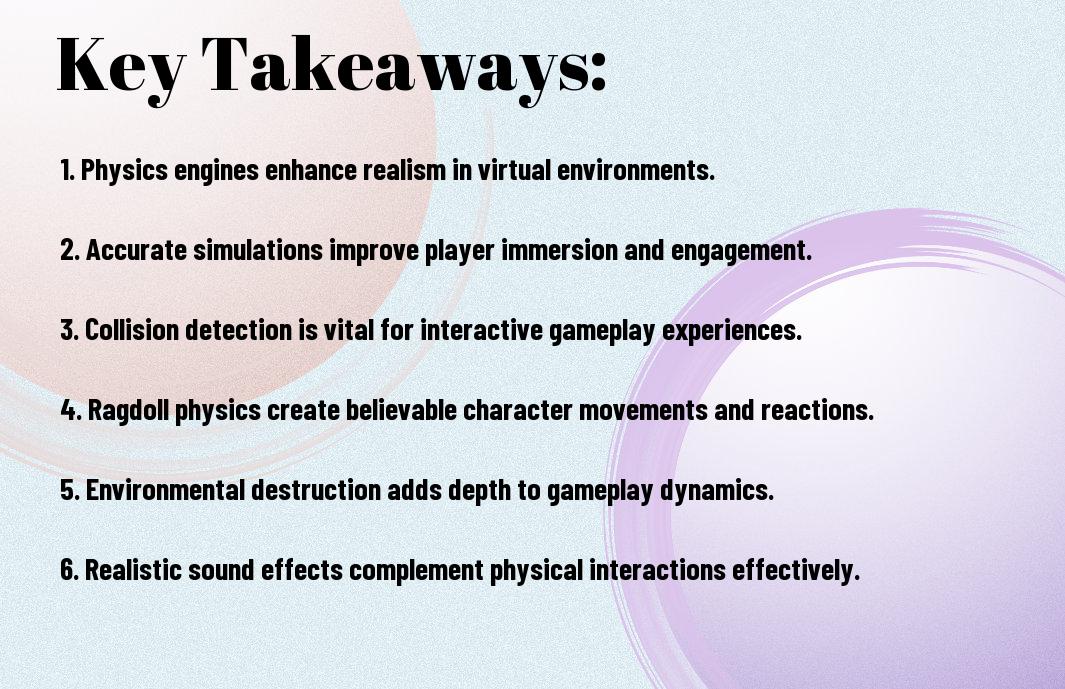
Key Takeaways:

  • Physics engines play a significant role in creating realistic gameplay experiences by simulating real-world physics and allowing for more immersive interactions within virtual environments.
  • Advanced physics engines enable developers to create detailed and accurate simulations of complex systems, such as destruction, water, and soft body dynamics, enhancing the overall realism of games.
  • The integration of physics engines in game development allows for more realistic character and object movements, making the gameplay feel more authentic and engaging.
  • Physics-based rendering and simulation can also contribute to a more believable and interactive game world, where players can manipulate objects and environments in a realistic manner.
  • Modern physics engines often include features such as collision detection, rigid body dynamics, and constraint solvers, which help to create a more realistic and responsive gameplay experience.
  • The use of physics engines can also facilitate the creation of more realistic special effects, such as explosions, fire, and smoke, adding to the overall visual fidelity of games.
  • As technology continues to advance, physics engines are likely to play an increasingly important role in game development, enabling the creation of even more realistic and immersive gaming experiences.

Core Principles of Game Physics

While developing a game, you can learn about the core principles of game physics from Advancements in Realistic Physics Simulation for Games to create a more immersive experience.

Newton’s Laws in Virtual Worlds

Worlds of physics in games rely on Newton’s laws, which you can apply to create realistic simulations, making your game more engaging and realistic.

Collision Detection and Response

Principles of collision detection and response are vital in game physics, allowing you to create a more realistic interaction between objects in your game.

Hence, as you research deeper into collision detection and response, you will discover that it involves complex algorithms and techniques to simulate real-world collisions, enabling you to create a more believable and interactive game environment that draws your players in.
Building Blocks of Physics Engines

Assuming you have a basic understanding of physics engines, you’ll find that they rely on several key components to simulate real-world interactions. These components work together to create a realistic gaming experience, drawing you into the virtual world.

Rigid Body Dynamics

One of the fundamental aspects of physics engines is rigid body dynamics, which allows you to simulate the motion of solid objects in your game world, enabling you to create more realistic collisions and interactions.

Particle Systems and Forces

For your game to truly come alive, you’ll need to incorporate particle systems and forces, which enable you to simulate complex phenomena like explosions, fire, and water, making your game more engaging and immersive.

And as you probe deeper into particle systems and forces, you’ll discover that they allow you to create a wide range of effects, from simple collisions to complex simulations, giving you the tools you need to craft a unique and captivating gaming experience that draws you in and keeps you invested in the world you’re creating.

Real-time Calculations

Once again, you find yourself immersed in a game, and the physics engine is working tirelessly behind the scenes to create a realistic experience, performing complex calculations in real-time to simulate the environment and objects within it.

Performance Optimization

Beneath the surface, your gaming experience is enhanced by optimization techniques that ensure smooth gameplay, as the physics engine is optimized to utilize your computer’s resources efficiently, minimizing lag and maximizing performance.

Frame Rate Dependencies

Dependent on the frame rate, your gaming experience can be significantly impacted, as a higher frame rate allows for more accurate and realistic physics simulations, while a lower frame rate can lead to choppy and unrealistic gameplay.

Performance is heavily influenced by frame rate dependencies, as you will notice that a higher frame rate provides a more immersive experience, with more realistic physics and smoother gameplay, allowing you to fully engage with the game world, and as you explore the game’s environment, you will appreciate the attention to detail that the physics engine brings to your experience.

Integration Methods

For a realistic gaming experience, you need to understand how physics engines integrate motion. You’ll explore various methods, including Euler and Verlet integration, to simulate real-world physics in your games.

Euler Integration

Following the basics, you’ll find that Euler integration is a simple method to update object positions and velocities. You can use this method to simulate basic physics, but it may not be accurate for complex simulations.

Verlet Integration

Below the surface of Euler integration, you’ll discover Verlet integration, which provides more accurate results. You can use this method to simulate complex physics, such as collisions and constraints, in your games.

Even with its advantages, Verlet integration has its limitations. You’ll need to consider factors like numerical stability and computational cost when implementing this method in your games. As you examine deeper, you’ll find that Verlet integration is particularly useful for simulations that require high accuracy, such as rigid body dynamics and collision detection, allowing you to create more realistic and engaging gameplay experiences.

Environmental Physics

After delving into the world of physics engines, you’ll notice how they simulate the environment in games, making your experience more immersive. Environmental physics encompasses various aspects, including terrain interaction and fluid dynamics, which work together to create a believable world.

Terrain Interaction

Against the backdrop of a game’s environment, you’ll encounter terrain that reacts to your actions, such as destructible objects or deformable ground, making your interactions feel more realistic.

Fluid Dynamics

For a more realistic experience, games utilize fluid dynamics to simulate water, fire, or smoke, allowing you to witness realistic interactions with your surroundings.

Also, as you explore the world of fluid dynamics in games, you’ll notice how it enhances your overall experience, with realistic simulations of water flow, ocean waves, or explosions, drawing you deeper into the game’s environment and making your actions feel more impactful.

Physics Engine Architecture

Many game developers rely on physics engines to create realistic simulations, and you can learn more about how they work by visiting Do video game engines use actual physics equations in their algorithms. This will give you a deeper understanding of the underlying mechanics.

Component-Based Systems

To create a robust physics engine, you’ll need to consider component-based systems, which allow for flexible and modular design, enabling you to easily add or remove features as needed in your game.

Multi-threading Approaches

By utilizing multi-threading approaches, you can significantly improve the performance of your physics engine, allowing for more complex simulations and smoother gameplay in your games.

Approaches to multi-threading involve distributing calculations across multiple cores, enabling you to take full advantage of your hardware and create more realistic and engaging experiences for your players, making your game more immersive and interactive.

To wrap up

Summing up, you now understand the significance of physics engines in creating realistic gaming experiences. You can appreciate how these engines simulate real-world physics, making your gameplay more immersive and engaging. As you explore various games, you will notice the impact of physics engines on your overall gaming experience, allowing you to interact with virtual environments in a more realistic and believable way, enhancing your enjoyment of the game.

FAQ

Q: What is the role of physics engines in achieving realism in motion in games?

A: Physics engines play a significant role in achieving realism in motion in games by simulating real-world physics and enabling game developers to create more realistic and immersive gameplay experiences. These engines use complex algorithms and mathematical models to simulate the behavior of objects in the game world, taking into account factors such as gravity, friction, and collisions. By accurately simulating the physical properties of objects and environments, physics engines help to create a more believable and engaging gaming experience for players.

Q: How do physics engines contribute to the overall gaming experience in terms of realism and immersion?

A: Physics engines contribute to the overall gaming experience by enabling the creation of realistic and interactive environments, characters, and objects. For example, a physics engine can simulate the way a character’s clothing and hair move in response to their actions, or the way a vehicle’s suspension responds to different road surfaces. This level of detail helps to create a more immersive and engaging experience for players, making them feel like they are an integral part of the game world. Additionally, physics engines can also be used to create realistic sound effects and visual effects, such as explosions, fire, and water simulations, which further enhance the overall gaming experience.

Q: What are some of the challenges and limitations of implementing physics engines in games, and how are they addressed by game developers?

A: One of the main challenges of implementing physics engines in games is the need to balance realism with performance and gameplay considerations. Physics simulations can be computationally intensive, which can impact game performance and frame rates. To address this challenge, game developers use various optimization techniques, such as level of detail (LOD) systems, physics-based rendering, and multi-threading, to ensure that the physics engine runs efficiently and smoothly. Another challenge is the need to fine-tune the physics engine to achieve the desired level of realism and gameplay feel, which can be a time-consuming and iterative process. Game developers address this challenge by using tools and software that allow them to tweak and adjust the physics engine’s parameters and settings, and by conducting extensive testing and player feedback to ensure that the game meets the desired level of realism and gameplay quality.

Game Engines Uncovered – The Tools Behind the Magic

As you research into the world of game development, you’ll discover that game engines are the backbone of your favorite games. You’ll learn that these powerful tools enable developers to bring their creative visions to life, handling everything from graphics and physics to sound and gameplay. Your understanding of game engines will take your appreciation of gaming to a new level, and in this post, you’ll get an in-depth look at the technology that makes your gaming experiences possible.

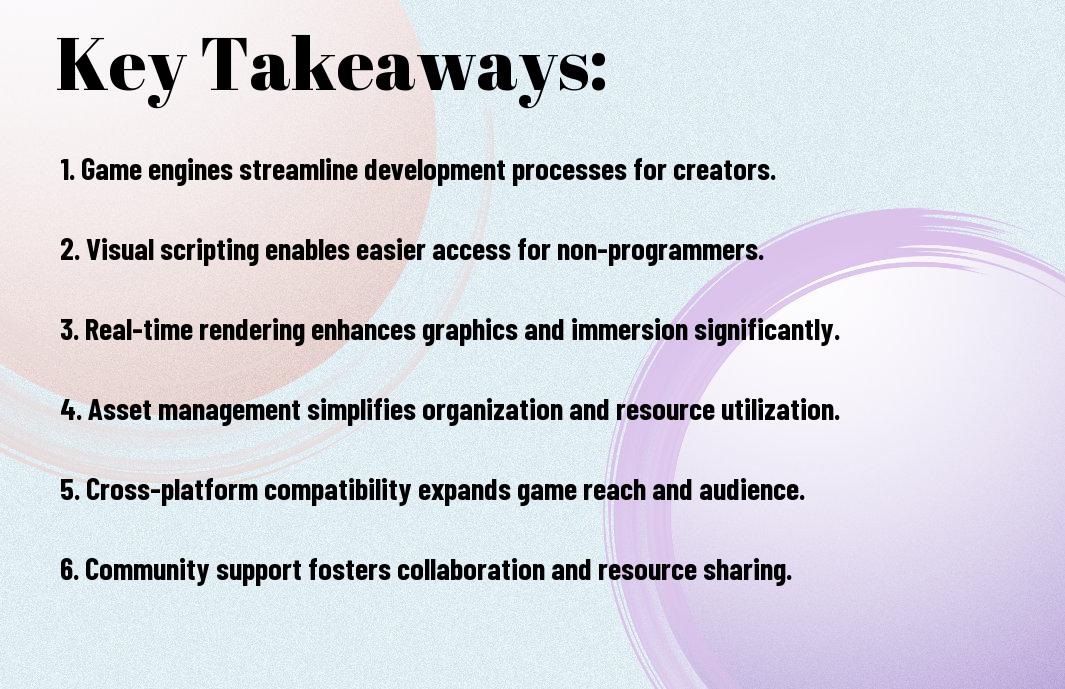
Key Takeaways:

  • Game engines are the backbone of the video game industry, providing the necessary tools and infrastructure to create immersive and engaging gaming experiences.
  • Popular game engines such as Unity and Unreal Engine offer a wide range of features and functionalities that cater to the needs of game developers, from 2D and 3D graphics to physics and animation.
  • Game engines have evolved significantly over the years, with advancements in technology leading to improved performance, enhanced graphics, and increased accessibility for developers.
  • The choice of game engine depends on the specific needs of the project, with factors such as platform support, programming language, and community support playing a significant role in the decision-making process.
  • Game engines often provide a vast array of tools and features that can be used to create a wide range of games, from casual mobile games to complex, open-world titles.
  • The use of game engines has also expanded beyond the gaming industry, with applications in fields such as architecture, education, and simulation.
  • As the gaming industry continues to grow and evolve, game engines will play an increasingly important role in shaping the future of interactive entertainment and beyond.

Core Architecture

Your game engine’s core architecture is the foundation upon which everything else is built, providing the framework for your game’s functionality and performance.

Main Engine Components

By examining the main components, you’ll find that they typically include rendering, physics, and audio engines, all working together to create a seamless gaming experience.

Runtime Systems

About the runtime systems, you’ll discover that they manage the game’s execution, handling tasks such as memory management and resource allocation.

Considering the complexity of runtime systems, you’ll need to understand how they optimize performance, minimize latency, and ensure a smooth gaming experience, allowing you to focus on creating engaging gameplay and immersive graphics, while the engine handles the underlying technical details, making your game development process more efficient and effective.

Rendering Pipeline

Any game engine’s rendering pipeline is a complex process that involves multiple stages, from scene preparation to final image display, allowing you to bring your virtual worlds to life.

Graphics Processing

By leveraging the power of graphics processing units (GPUs), you can handle massive amounts of data and perform complex calculations, enabling your game to render high-quality graphics and immersive environments.

Shader Management

Below the surface of your game’s visuals, shader management plays a significant role in controlling the appearance of objects and scenes, giving you the ability to customize and optimize your game’s look and feel.

Consequently, as you examine deeper into shader management, you’ll discover that it involves creating, editing, and applying shaders to various objects and materials in your game, allowing you to achieve the desired visual effects and balance performance with quality, making your game more engaging and realistic for your players.

Physics and Collision Systems

Unlike other aspects of game development, physics and collision systems are what bring your game to life, allowing you to create immersive and realistic interactions between objects in your virtual world.

Physics Simulation

Besides being a fundamental component of game engines, physics simulation enables you to model real-world phenomena, such as gravity, friction, and motion, making your game more engaging and believable to you and your players.

Collision Detection

After setting up your physics simulation, collision detection comes into play, enabling you to determine when objects intersect or come into contact with each other, allowing you to create a more realistic and interactive experience for your players.

Indeed, as you examine deeper into collision detection, you’ll discover that it’s a complex process that involves sophisticated algorithms and techniques to accurately detect and respond to collisions in your game, and you’ll need to consider factors such as object shape, size, and velocity to create a seamless and realistic experience for your players.

Asset Management

Many game developers understand the importance of efficient asset management, as it directly impacts your game’s performance. You can learn more about the evolution of game engines and their components by checking out Unbundling the Game Engine: The Rise of Next-Generation Game Engines, which provides valuable insights into the industry’s trends.

Resource Loading

With proper resource loading techniques, you can significantly reduce your game’s loading times, ensuring a smoother experience for your players. You’ll want to explore various methods to optimize resource loading, such as asynchronous loading and caching, to achieve the best results.

Memory Optimization

Asset management involves careful memory optimization to prevent performance issues. You’ll need to consider factors like texture compression, mesh simplification, and data structures to minimize memory usage and ensure your game runs smoothly on various devices.

Consequently, as you probe deeper into memory optimization, you’ll discover that it’s vital to profile your game regularly to identify memory leaks and bottlenecks. By doing so, you’ll be able to make data-driven decisions to optimize your game’s performance, ultimately enhancing your players’ overall experience. You’ll find that optimizing memory usage is an ongoing process that requires careful planning, testing, and refinement to achieve the best results.

Scripting and Logic

After delving into the world of game engines, you’ll discover that scripting and logic are crucial components. You’ll use these tools to bring your game to life, creating interactive and immersive experiences for your players.

Programming Interfaces

Before you start scripting, you’ll need to familiarize yourself with the programming interfaces provided by the game engine. You’ll use these interfaces to write code, create scripts, and implement logic that drives your game’s behavior and mechanics.

Event Systems

Around the core of your game, event systems play a vital role in handling user input, collisions, and other interactions. You’ll use event systems to respond to these events, creating a dynamic and engaging experience for your players.

Even as you work with event systems, you’ll find that they offer a high degree of flexibility and customization. You can use them to create complex behaviors, trigger animations, and control the flow of your game, allowing you to craft a unique and captivating experience that draws your players in and keeps them engaged.

Audio Engine Integration

Not only do game engines provide stunning visuals, but they also offer advanced audio capabilities. You can learn more about how game engines are optimising VFX and reshaping visual media, which can help you understand the importance of audio in game development.

Sound Processing

By leveraging the audio engine, you can create immersive soundscapes that enhance your gaming experience. You’ll be able to process and manipulate sound effects, music, and voiceovers with ease, allowing you to craft a unique audio identity for your game.

Spatial Audio

With the help of spatial audio, you can pinpoint the source of sounds in 3D space, creating a more realistic and engaging experience. You’ll be able to simulate the way sound behaves in the real world, making your game feel more immersive and interactive.

Considering the impact of spatial audio on your game, you’ll want to explore the various techniques and tools available to create a convincing audio environment. You can use audio plugins, 3D audio processing, and other advanced features to create a rich and detailed soundscape that draws your players in and refuses to let go, allowing you to take your game to the next level and provide an unforgettable experience for your players.

To wrap up

So, as you now have a deeper understanding of game engines, you can appreciate the complexity behind your favorite games. You’ve learned about the tools that bring virtual worlds to life, and how they impact your gaming experience. With this knowledge, you can better appreciate the craftsmanship that goes into creating immersive games, and perhaps even inspire you to try your hand at game development, exploring the endless possibilities that game engines have to offer, and shaping your own gaming experiences.

FAQ

Q: What is a game engine and how does it contribute to the development of a game?

A: A game engine is a software framework that provides the necessary tools and infrastructure to build and run a game. It acts as the backbone of the game, handling tasks such as rendering graphics, processing physics, and managing game logic. With a game engine, developers can focus on creating game content, such as characters, levels, and storylines, without having to build everything from scratch. Popular game engines like Unity and Unreal Engine offer a wide range of features and tools that make game development more efficient and cost-effective.

Q: What are the key features and tools that a game engine typically provides to game developers?

A: A game engine typically provides a range of features and tools that enable developers to create and customize their game. These may include a graphics rendering engine, physics engine, animation tools, audio management, scripting languages, and level editors. Additionally, many game engines offer advanced features such as dynamic lighting, particle effects, and multiplayer support. Some game engines also provide built-in tools for debugging, testing, and optimizing game performance, making it easier for developers to identify and fix issues. Overall, the features and tools provided by a game engine can greatly impact the quality and functionality of the final game.

Q: How do game engines like Unity and Unreal Engine support the development of different types of games, such as 2D, 3D, VR, and AR experiences?

A: Game engines like Unity and Unreal Engine are designed to be versatile and adaptable, allowing developers to create a wide range of game types and genres. For 2D games, these engines provide tools for creating and managing sprites, animations, and user interfaces. For 3D games, they offer advanced features such as 3D modeling, texturing, and physics simulation. For VR and AR experiences, the engines provide support for tracking devices, spatial audio, and stereoscopic rendering. Additionally, many game engines offer templates, tutorials, and asset stores that make it easier for developers to get started with their project, regardless of the type of game they are creating. By providing a flexible and feature-rich environment, game engines enable developers to focus on creating engaging and immersive game experiences for players.

HT-fff Skip to content