Creativity

Simulation Games – When Realism Meets Creativity

As you probe into the world of simulation games, you’ll discover a unique blend of realism and creativity. You’ll have the opportunity to experience realistic scenarios, making decisions that impact virtual worlds. Your creativity will be sparked, allowing you to build, manage, and shape your own environments. With simulation games, you can explore various industries, from farming to city planning, and everything in between, offering a unique gaming experience that’s both entertaining and educational.

Key Takeaways:

  • Simulation games offer a unique blend of realism and creativity, allowing players to experience realistic scenarios while also expressing their imagination and innovation, making for a highly engaging and immersive experience.
  • The intersection of realism and creativity in simulation games enables players to experiment with different outcomes, test hypotheses, and learn from their mistakes in a safe and controlled environment, promoting problem-solving skills and strategic thinking.
  • By combining realistic elements with creative freedom, simulation games can cater to a wide range of players, from those who enjoy realistic simulations to those who prefer more fantastical or experimental experiences, making them a versatile and appealing genre for gamers of all interests.

    The Evolution of Simulation Games

    A look back at the history of simulation games shows significant growth, with your experience evolving from simple text-based interfaces to immersive, interactive worlds.

    From Simple Mechanics to Complex Systems

    Games like the original SimCity laid the groundwork, allowing you to build and manage your own cities, and as you progressed, more complex systems were introduced.

    Technical Advancements in Simulation

    Across various platforms, you’ve seen improvements in graphics, physics, and AI, enabling more realistic simulations that draw you in and challenge your skills.

    Systems such as weather, economics, and ecology are now intricately woven into your simulation experiences, providing you with a deeper, more engaging experience that tests your ability to adapt and thrive in dynamic environments, as you navigate the complexities of your virtual world.

    Reality vs. Creative Freedom

    It is a delicate balance that simulation games strive to achieve, blending realistic elements with creative freedom to craft an immersive experience for you, the player.

    Balancing Authenticity with Entertainment

    The key to a successful simulation game lies in finding a balance between authenticity and entertainment, allowing you to engage with the game world in a way that feels both realistic and enjoyable.

    Player Agency and Storytelling

    The ability to make choices and shape the narrative is a key aspect of simulation games, giving you the power to drive the story forward and create a unique experience tailored to your preferences.

    Reality check is not the only factor in simulation games, as you are also looking for an engaging story and the ability to make choices that impact the game world, and simulation games offer you the opportunity to explore different scenarios and storylines, allowing you to experiment and learn from your decisions, making the experience even more immersive and interactive.

    Core Elements of Modern Simulation Games

    Now, as you investigate into the world of simulation games, you’ll notice that they often feature a mix of realistic and creative elements, making for a unique gaming experience.

    Physics and Environmental Systems

    Modern simulation games incorporate complex physics and environmental systems, allowing you to interact with your virtual world in a realistic way, and influencing your overall gaming experience.

    AI and Dynamic Interactions

    Below the surface of simulation games lies a sophisticated AI system, enabling dynamic interactions between you and non-playable characters, making your experience more immersive and engaging.

    Hence, as you explore the world of simulation games, you’ll find that the AI and dynamic interactions play a significant role in creating a believable and responsive environment, allowing you to make choices and shape your own story, and influencing the outcome of your actions in a way that feels realistic and satisfying.
    Genre-Defining Features

    Many simulation games offer a unique blend of realism and creativity, allowing you to explore and interact with virtual worlds in a highly immersive way. You can build, manage, and shape your own experiences, making each gameplay session unique and engaging.

    Management and Resource Systems

    Upon entering the world of simulation games, you’ll often encounter complex management and resource systems that challenge you to optimize your strategies and make the most of your virtual resources, enabling you to achieve your goals and progress through the game.

    Consequence-Based Gameplay

    Consistently, consequence-based gameplay is a key aspect of simulation games, where your decisions have a direct impact on the game world and its inhabitants, allowing you to learn from your mistakes and adapt your approach to achieve success.

    Consequently, as you play simulation games, you’ll find that the consequences of your actions can be far-reaching, influencing the environment, characters, and overall narrative, making your experience even more engaging and realistic, and allowing you to develop a deeper understanding of the game’s mechanics and systems, which in turn enables you to make more informed decisions and shape the game world to your liking.

    Creative Expression in Simulation

    Despite the focus on realism, simulation games offer a wide range of creative possibilities, allowing you to express yourself in unique and innovative ways, making your experience even more engaging and personalized.

    Player-Created Content

    Creatively, you can design and share your own content, such as custom maps, scenarios, or game modes, which can be used to showcase your imagination and skills, and even shared with the community.

    Customization and Modification

    Anyway, you have the freedom to customize and modify various aspects of the game, such as characters, vehicles, or environments, to suit your preferences, giving you a sense of ownership and control over your gaming experience.

    Content creators have taken customization to the next level, producing intricate mods that can completely overhaul the game, offering you new and exciting ways to play, and allowing you to experiment with different styles and approaches, making your experience even more enjoyable and dynamic.

    Impact on Real-World Learning

    For your learning experience, simulation games can be highly effective. You can Discover the Most Realistic Games of All Time: Realism Meets Gameplay to enhance your skills.

    Professional Training Applications

    One of the significant advantages of simulation games is their application in professional training, allowing you to practice and improve your skills in a virtual environment.

    Educational Benefits

    About the benefits of simulation games, you’ll find that they offer a unique learning experience, making complex concepts more engaging and accessible.

    For instance, when you play simulation games, you can develop problem-solving skills, critical thinking, and decision-making abilities, all of which are valuable in real-life situations, and you can apply them to your everyday life, making you more confident and self-assured in your abilities.

    Final Words

    On the whole, you will find that simulation games offer a unique experience where realism meets creativity, allowing you to explore new worlds and scenarios. As you engage with these games, you will discover that your imagination and problem-solving skills are put to the test. Your ability to adapt and make decisions will be challenged, making simulation games an engaging and immersive experience that you will want to revisit time and time again.

    FAQ

    Q: What are simulation games and how do they combine realism with creativity?

    A: Simulation games are a type of video game that simulates real-world activities, environments, or scenarios, offering players a realistic experience while also allowing for creative freedom. These games can range from simulating everyday life, managing cities, or even piloting aircraft, and they often blend realistic mechanics with creative elements such as building, designing, or problem-solving, providing a unique gaming experience.

    Q: What types of simulation games are available, and how do they cater to different interests?

    A: Simulation games are diverse and cater to a wide range of interests. For example, life simulation games like “The Sims” allow players to create and manage their own characters and communities. City-building simulations like “SimCity” challenge players to design, build, and manage their own cities. Then there are flight simulations, sports simulations, and even farming simulations, each offering a unique blend of realism and creativity tailored to different player preferences.

    Q: How do simulation games balance realism with creative freedom, and what are the benefits of this balance?

    A: Simulation games balance realism with creative freedom by incorporating realistic rules, mechanics, and environments while also providing players with the ability to make choices, customize, and innovate within the game world. This balance allows players to learn about real-world systems and processes in an engaging way, while also expressing their creativity and experimenting with different scenarios and outcomes. The benefits include enhanced gameplay, deeper player engagement, and the opportunity for players to develop problem-solving skills and strategic thinking.

    Q: Can simulation games be used for educational purposes, and if so, how effective are they as learning tools?

    A: Yes, simulation games can be highly effective as educational tools. By simulating real-world scenarios and systems, these games can teach players about complex concepts, historical events, or professional skills in an interactive and memorable way. They can help learners develop critical thinking, decision-making, and problem-solving skills, all within a controlled, safe environment. Many educational institutions and professional training programs are now incorporating simulation games as part of their curriculum or training modules, highlighting their potential as a valuable learning resource.

    Q: How is the future of simulation games evolving, and what new features or technologies can we expect to see in upcoming games?

    A: The future of simulation games is promising, with advancements in technology expected to introduce more realistic graphics, complex AI, and immersive gameplay experiences. The integration of virtual reality (VR) and augmented reality (AR) technologies will likely play a significant role, offering players even more realistic and interactive experiences. Additionally, the incorporation of online features will continue to enhance multiplayer aspects, allowing for collaborative gameplay and community building. As game development tools become more accessible, we can also expect to see more indie simulation games that offer unique perspectives and gameplay mechanics, further diversifying the simulation game genre.

The Rise of Sandbox Games – Unleashing Creative Freedom

As you explore the world of gaming, you’ve likely noticed a shift towards sandbox games that offer unparalleled creative freedom. You’re no longer limited to linear storylines, instead, you’re given the power to shape your own experiences. With your imagination as the only boundary, you can build, explore, and interact with virtual worlds in ways that were previously unimaginable. Your gaming experience is about to get a whole lot more personal and exciting, and this blog post will examine into the details of this gaming revolution.

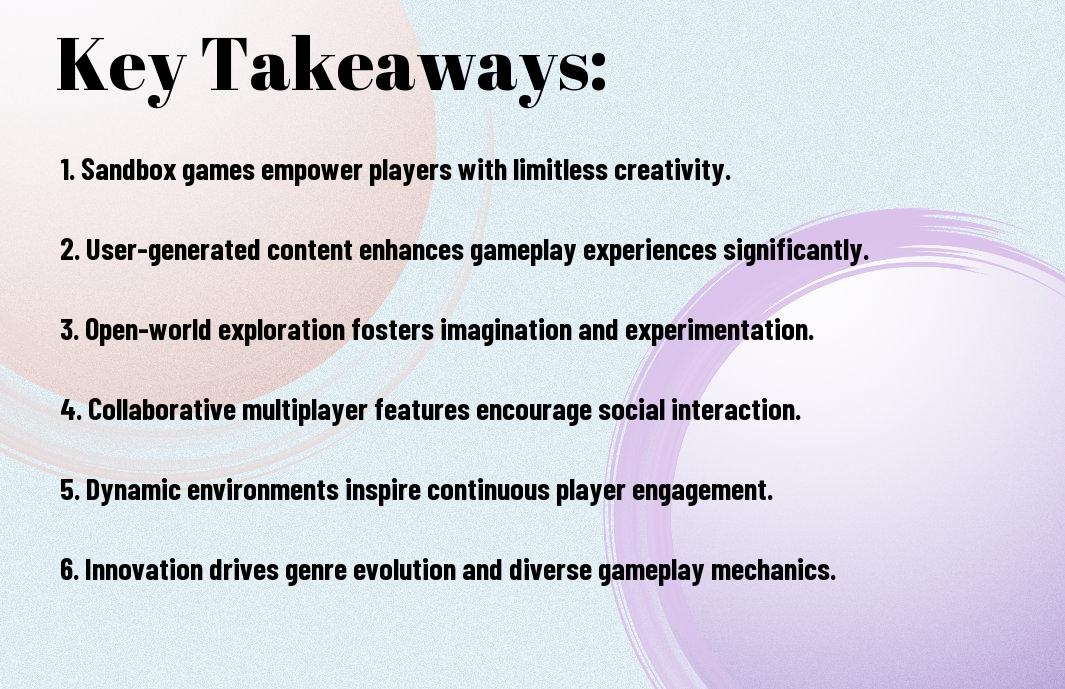
Key Takeaways:

  • The rise of sandbox games has led to a significant shift in the gaming industry, offering players unprecedented creative freedom and immersive experiences.
  • Sandbox games provide players with open-world environments, allowing them to explore, experiment, and express themselves in unique and innovative ways.
  • Games like Minecraft and Terraria have popularized the sandbox genre, inspiring a new generation of gamers and game developers to embrace creative freedom and open-ended gameplay.
  • Sandbox games often feature procedurally generated content, which enables endless possibilities for exploration and discovery, keeping players engaged for hours on end.
  • The creative freedom offered by sandbox games has also led to the development of vibrant online communities, where players share their creations, collaborate on projects, and learn from one another.
  • Sandbox games have also become an important tool for education and learning, allowing players to develop crucial skills such as problem-solving, critical thinking, and creativity in a fun and interactive way.
  • The success of sandbox games has paved the way for new and innovative genres, such as survival games and open-world RPGs, which continue to push the boundaries of creative freedom and immersive gameplay.

Evolution of Sandbox Gaming

The concept of sandbox gaming has undergone significant transformations over the years, offering you a unique experience with each new iteration. As you explore the world of sandbox games, you’ll notice a shift from restrictive gameplay to open-world adventures.

From Linear to Open World

Gamers have witnessed a remarkable transition from linear gameplay to open-world experiences, allowing you to explore and interact with your surroundings in a more immersive way. You can now experiment with different playstyles and storylines, making your gaming experience more personalized.

Technical Milestones

Toward the development of more sophisticated sandbox games, advancements in technology have played a significant role, enabling you to enjoy seamless gameplay and stunning visuals. You can appreciate the attention to detail and complexity of the game worlds, making your experience even more engaging.

Indeed, as you research deeper into the world of sandbox games, you’ll notice that technical milestones have been instrumental in shaping your gaming experience. You can now enjoy features like dynamic weather, destructible environments, and advanced AI, all of which contribute to a more realistic and interactive gameplay experience, allowing you to express your creativity and freedom in a virtual world tailored to your preferences.

Core Elements of Sandbox Design

While designing a sandbox game, you can draw inspiration from various sources, such as The Sandbox Game: Unleashing Creativity and Freedom, to create an immersive experience, allowing you to unleash your creative freedom.

Player Agency

Besides the game’s overall design, you will notice that player agency plays a significant role in sandbox games, as it enables you to make choices that impact the game world, giving you a sense of control and ownership over your experience.

Environmental Interaction

Below the surface of a sandbox game’s open world, you will find a complex system of interactions that allow you to manipulate and shape the environment, creating a unique and dynamic experience tailored to your preferences.

Hence, as you explore the world of sandbox games, you will discover that environmental interaction is a key aspect of the genre, enabling you to build, explore, and experiment with the game’s world, unlocking new possibilities and discovering hidden secrets, and allowing you to express your creativity and bring your ideas to life.

Creative Tools and Mechanics

All sandbox games offer a wide range of creative tools and mechanics that allow you to express your imagination and bring your ideas to life. You can build, explore, and interact with the game world in a way that feels intuitive and engaging.

Building Systems

Behind every great sandbox game is a robust building system that lets you construct and shape the world around you. You can use various materials and tools to create structures, from simple shelters to complex machines, and experiment with different designs and layouts.

Resource Management

At the heart of every sandbox game is a resource management system that challenges you to gather, craft, and utilize resources effectively. You must balance your needs and priorities, making tough decisions about how to allocate your resources and optimize your gameplay experience.

Systems like resource management enable you to develop a sense of ownership and investment in your gameplay experience. As you gather and manage resources, you will uncover new items, tools, and recipes that expand your creative possibilities and open up new avenues for exploration and discovery, allowing you to tailor your experience to your unique preferences and playstyle.

Social Impact and Community

Your engagement with sandbox games extends beyond the virtual world, as you become part of a larger community that shares your passion for creative freedom and self-expression.

Player-Created Content

Following the rise of sandbox games, you’ll find a plethora of user-generated content that showcases your creativity and talent, inspiring others to do the same.

Shared Experiences

Collectively, you and your fellow players create a unique and dynamic environment that fosters collaboration and social interaction, leading to lasting memories and a sense of belonging.

Shared experiences in sandbox games allow you to connect with like-minded individuals, learn from their approaches, and adapt their ideas to enhance your own gameplay, ultimately enriching your overall experience.

Genre-Defining Games

For your understanding of sandbox games, it’s important to explore the titles that have shaped the genre, offering you unparalleled creative freedom and immersive experiences.

Minecraft’s Revolution

The emergence of Minecraft marked a significant turning point, as you were able to build and explore vast blocky worlds, sparking your imagination and creativity.

GTA’s Open World Legacy

At the forefront of open-world gaming, Grand Theft Auto (GTA) series has been a benchmark, allowing you to roam freely and engage in various activities, setting a high standard for your gaming expectations.

Further exploring GTA’s open-world legacy, you’ll find that the series has consistently pushed boundaries, providing you with richly detailed environments, complex characters, and engaging storylines, ultimately influencing your perception of what a sandbox game should offer, and you can expect similar experiences from other games in the genre, as they strive to match the standard set by GTA.

Future Directions

Now that sandbox games have become a staple of the gaming industry, you can expect even more innovative and immersive experiences to emerge, offering you unparalleled creative freedom and endless hours of entertainment.

Emerging Technologies

Between the advancements in virtual reality and artificial intelligence, you will witness a new era of sandbox games that blur the lines between the physical and virtual worlds, allowing you to interact with your environment in unprecedented ways.

Procedural Generation

Along with the growth of sandbox games, you will see a greater emphasis on procedural generation, enabling you to create unique and dynamic worlds that are tailored to your preferences and playstyle, offering you a distinct experience each time you play.

To fully appreciate the potential of procedural generation, you should consider how it can be used to create complex and diverse environments, complete with their own ecosystems, geography, and rules, allowing you to explore and interact with your surroundings in a highly realistic and engaging manner, and as you probe deeper into these worlds, you will discover that the possibilities are endless, and your creativity is the only limit.

Summing up

Drawing together the threads of the rise of sandbox games, you can see how they offer you unparalleled creative freedom. As you explore these virtual worlds, you unlock your imagination and bring your unique ideas to life. With the ability to shape and mold your experience, you are no longer limited by traditional gameplay boundaries, and your creativity knows no bounds, allowing you to enjoy a truly immersive experience.

FAQ

Q: What are sandbox games and how do they promote creative freedom?

A: Sandbox games are a type of video game that offers players a high degree of autonomy and creative freedom, allowing them to explore, build, and interact with a virtual world in a non-linear fashion. These games provide players with a set of tools, resources, and rules, but do not dictate a specific objective or storyline, enabling players to express themselves and bring their imagination to life. By providing an open-ended and dynamic environment, sandbox games unleash creative freedom, encouraging players to experiment, innovate, and push the boundaries of what is possible within the game world.

Q: What are some notable examples of sandbox games that have contributed to their rise in popularity?

A: Some notable examples of sandbox games that have contributed to their rise in popularity include Minecraft, Terraria, and Grand Theft Auto V. Minecraft, for instance, has become a cultural phenomenon, allowing players to build and explore a blocky, pixelated world filled with creatures, resources, and treasures. Terraria, on the other hand, offers a 2D sandbox experience, where players can dig, build, and battle their way through a procedurally generated world. Grand Theft Auto V, an open-world sandbox game, provides players with a vast, detailed environment to explore, complete with a rich storyline, engaging characters, and a wide range of activities and missions.

Q: How have sandbox games influenced the gaming industry and what can we expect from future sandbox game developments?

A: The rise of sandbox games has significantly influenced the gaming industry, as they have changed the way games are designed, developed, and played. Sandbox games have raised the bar for player engagement, creativity, and immersion, forcing game developers to rethink their approach to game design and player interaction. As for future developments, we can expect to see even more sophisticated and immersive sandbox games, with advanced graphics, physics, and artificial intelligence. The incorporation of new technologies, such as virtual reality (VR) and augmented reality (AR), will further enhance the sandbox gaming experience, providing players with even more realistic and interactive environments to explore and create within.

HT-fff Skip to content