
Key Takeaways:
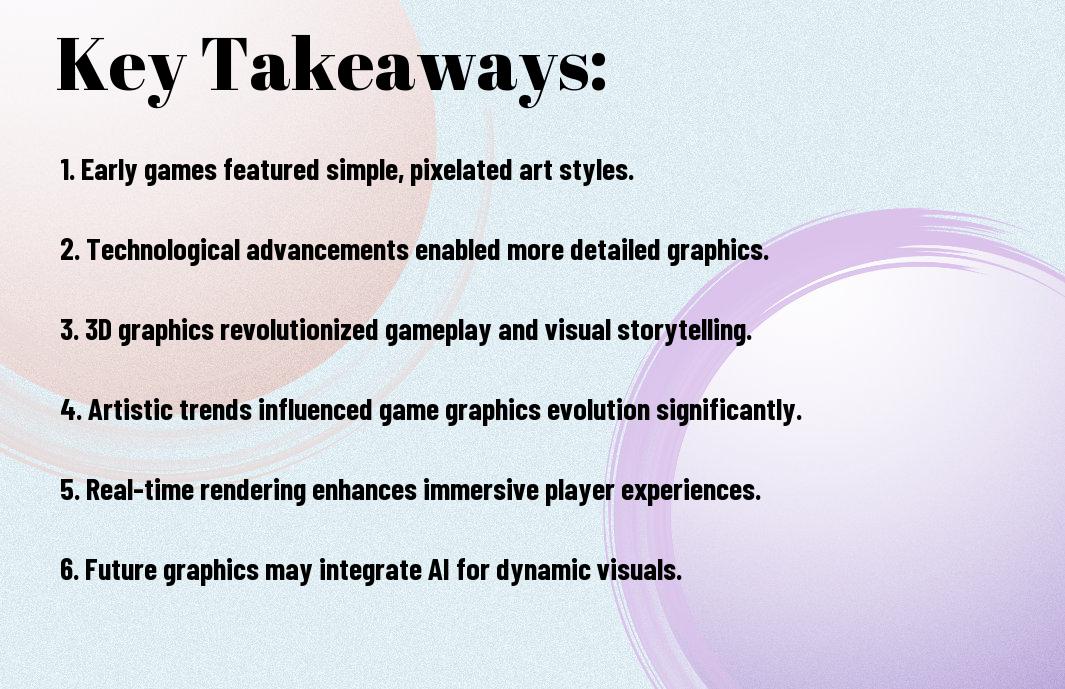
- The evolution of gaming graphics has transformed significantly over the years, from basic pixel art to stunning photorealism, enhancing the overall gaming experience.
- Early gaming graphics were limited by technological constraints, but advancements in hardware and software have enabled the development of more complex and detailed visuals.
- The introduction of 3D graphics marked a significant milestone in the evolution of gaming graphics, offering a new level of immersion and engagement for players.
- The use of textures, lighting, and shading has become increasingly sophisticated, allowing for more realistic and detailed environments and characters.
- Modern gaming graphics often incorporate advanced techniques such as motion capture, physics engines, and artificial intelligence to create a more realistic and interactive experience.
- The rise of virtual reality (VR) and augmented reality (AR) technologies is pushing the boundaries of gaming graphics even further, enabling players to step into fully immersive virtual worlds.
- As gaming graphics continue to evolve, we can expect to see even more stunning and realistic visuals, further blurring the line between games and reality.
The Birth of Gaming Graphics
Before plunging into the evolution of gaming graphics, you need to understand the humble beginnings of this industry. You will explore how simple graphics paved the way for modern gaming.
Early Pixel Art Era (1970s-1980s)
The first games featured basic pixel art, with you seeing blocky characters and simple environments that sparked your imagination.
Color Revolution and 8-bit Design
By the 1980s, you witnessed the introduction of color and 8-bit design, which brought new excitement to your gaming experience with more vibrant and detailed graphics.
Understanding the color revolution and 8-bit design, you can see how it enabled developers to create more engaging games, with you enjoying a wider range of colors and slightly more complex graphics, setting the stage for future advancements in gaming technology.
The 16-bit Renaissance
Any gamer who experienced the 16-bit era will tell you that it was a time of significant growth for the industry, with consoles like the Sega Genesis and Super Nintendo Entertainment System (SNES) pushing the boundaries of what was possible in gaming graphics.
Enhanced Sprite Design
Behind the scenes, developers were working tirelessly to create more detailed and complex sprites, allowing you to enjoy more immersive gaming experiences, with characters and environments that were more detailed than ever before.
Animation Breakthroughs
On the animation front, you saw significant advancements, with smoother and more realistic movements, making your gaming experience more engaging and believable.
For instance, you can see the difference in animation quality when comparing games from the 8-bit era to those from the 16-bit era, with the latter offering more fluid movements and detailed animations, drawing you deeper into the game world.
3D Graphics Revolution
Once again, you find yourself at the forefront of a gaming revolution, as 3D graphics take center stage. This era brings unparalleled immersion, with environments and characters that seem to leap off the screen.
Polygon-Based Gaming
Besides the initial wow factor, you’ll notice that 3D games rely on polygons to create their visuals. As you explore these early 3D worlds, you’ll see the building blocks of this new technology.
Early 3D Rendering Techniques
For your understanding of 3D graphics, it’s crucial to know that early rendering techniques involved simple textures and lighting. You’ll notice the limitations of these methods as you play through classic 3D games.
Also, as you investigate deeper into the world of early 3D rendering, you’ll discover techniques like ray casting and voxel rendering, which paved the way for modern graphics. You’ll appreciate the complexity and challenges that developers faced in creating immersive 3D environments, and how these early innovations have influenced the stunning visuals you enjoy today.

The Rise of Realism
All gamers have witnessed the significant advancements in gaming graphics over the years, and one of the most notable developments is the rise of realism. You can see the improvements in the details, textures, and overall visual quality of games.
Texture Mapping Evolution
Around the mid-1990s, texture mapping became more sophisticated, allowing for more detailed and realistic environments. You can notice the difference in the way textures are applied to characters and objects, making your gaming experience more immersive.
Lighting and Shadow Systems
For instance, the introduction of advanced lighting and shadow systems has enabled developers to create more realistic atmospheres. You can observe how lighting affects the mood and overall aesthetic of a game, drawing you deeper into the virtual world.
Lighting has become a key element in modern games, as it can greatly enhance the visual fidelity and create a more engaging experience for you. As you play, you’ll notice how lighting interacts with the environment, characters, and objects, creating a more believable and captivating atmosphere that draws you in and refuses to let go.
Modern Gaming Graphics
To experience the latest advancements in gaming graphics, you can explore the current generation of consoles and PCs, which offer stunning visuals and immersive gameplay. You will notice significant improvements in lighting, textures, and overall detail, making your gaming experience more engaging.
Ray Tracing Technology
By leveraging the power of ray tracing, you can enjoy more realistic lighting and reflections in your games, enhancing your overall gaming experience. You will notice accurate lighting simulations, making the game world feel more authentic and engaging.
Photogrammetry Applications
For instance, you can use photogrammetry to create highly detailed environments and characters in your games, allowing you to step into a more realistic world. You will be able to appreciate the level of detail and realism that photogrammetry brings to your gaming experience.
To take full advantage of photogrammetry applications, you can explore games that utilize this technology to create immersive and realistic environments. You will be able to appreciate the level of detail and realism that photogrammetry brings to your gaming experience, making it feel more engaging and interactive, allowing you to explore and interact with your surroundings in a more realistic way.
Artistic Choices in Gaming
For you, as a gamer, the evolution of gaming graphics is not just about technical advancements, but also about the artistic choices that shape your gaming experience. You notice how different styles and approaches can completely transform the way you interact with a game.
Stylized vs. Realistic Approaches
Between the two extremes of stylized and realistic graphics, you can see a wide range of creative possibilities. You observe how stylized graphics can create a unique atmosphere, while realistic graphics can draw you into a more immersive world.
The Return of Pixel Art
With the resurgence of pixel art, you are experiencing a nostalgic yet refreshed take on classic gaming graphics. You find that pixel art can be both charming and challenging, offering a distinct aesthetic that sets it apart from other styles.
Stylized pixel art, in particular, allows you to appreciate the attention to detail and craftsmanship that goes into creating each pixel. You can see how the deliberate choice of pixel art can add a layer of depth and personality to a game, making your experience even more engaging and enjoyable.
To wrap up
So, as you look back on the journey from pixel art to photorealism, you can appreciate the significant advancements in gaming graphics. You’ve seen how your gaming experience has evolved, with improved visuals and more immersive gameplay. Your understanding of the evolution of gaming graphics has likely deepened, giving you a new appreciation for the technology behind your favorite games.
FAQ
Q: What is the significance of pixel art in the evolution of gaming graphics?
A: Pixel art marked the beginning of the gaming graphics era, with its distinctive aesthetic and technical limitations. The early days of gaming saw the use of pixel art due to hardware constraints, but it also led to the development of unique and charming visual styles that are still admired today. As technology improved, pixel art paved the way for more complex graphics, and its influence can still be seen in many modern games that incorporate retro elements or pay homage to the early days of gaming.
Q: How did the transition from 2D to 3D graphics impact the gaming industry?
A: The shift from 2D to 3D graphics revolutionized the gaming industry, offering unprecedented levels of immersion and realism. The introduction of 3D graphics enabled developers to create more engaging and interactive environments, characters, and storylines. This transition also led to the development of new genres, such as first-person shooters and open-world games, which have become incredibly popular. The move to 3D graphics raised the bar for game development, driving innovation and pushing the boundaries of what was thought possible in gaming.
Q: What role does photorealism play in modern gaming, and how has it enhanced the gaming experience?
A: Photorealism has become a key aspect of modern gaming, with many games striving to achieve highly realistic visuals that simulate the real world. The pursuit of photorealism has led to significant advancements in graphics technology, including the development of advanced lighting systems, detailed textures, and complex character models. Photorealism has enhanced the gaming experience by creating a sense of presence and immersion, drawing players into the game world and making the experience feel more authentic and engaging. As technology continues to evolve, photorealism is likely to play an increasingly important role in shaping the future of gaming graphics.


